












Have you ever had a friend who keeps waiting for an ex who’s clearly not coming back? And you listen to them rant their feeling of holding on, hoping, and getting nothing? That whole emotional cycle might sound dramatic, but it’s surprisingly close to what you’ll see on stage.
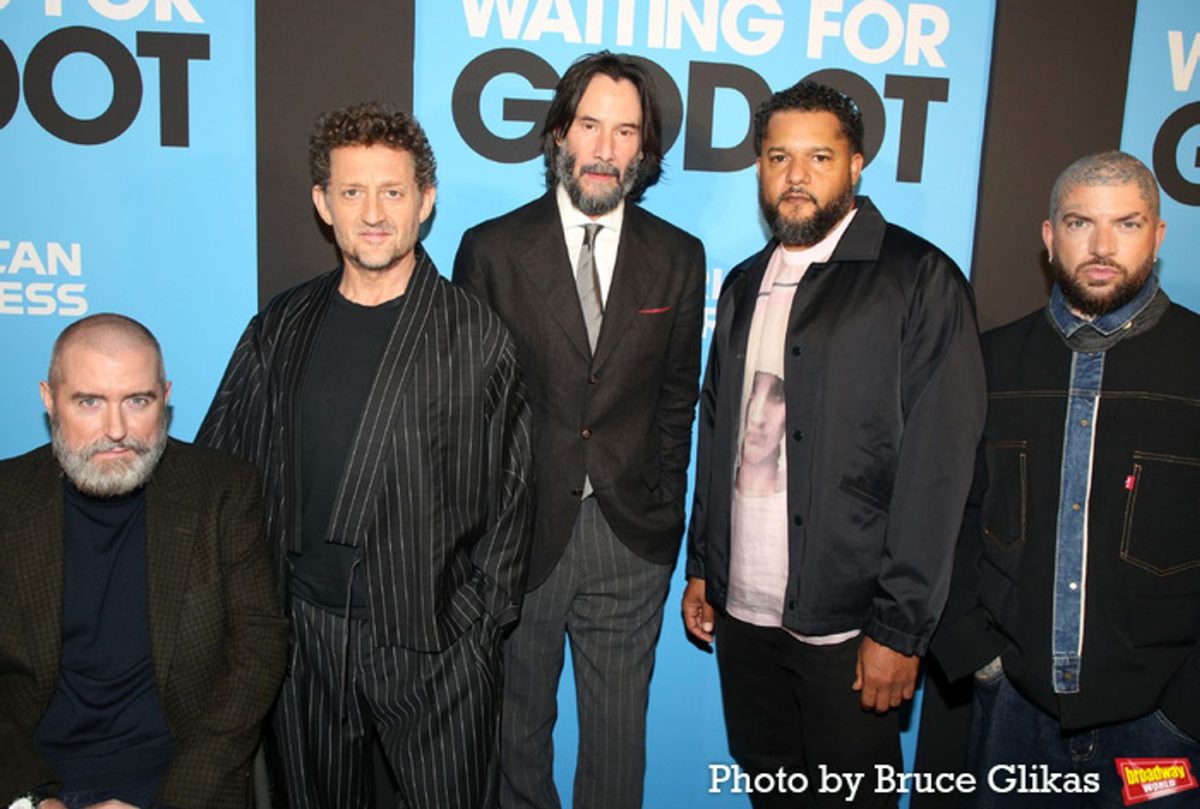
In Jamie Lloyd’s 2025 production of Waiting for Godot performed in Hudson Theater 141 West 44th Street New York, starring Keanu Reeves and Alex Winter, that simple idea of waiting for someone who never arrives becomes weirdly relatable and philosophical.
Jamie Lloyd is a director who loves taking old classical places and making them feel new again. A lot of his projects are revivals, but puts his own modern minimal twist on them to enhance the audiences’ experience. He is also known for making his company give cheaper and easier access to a theater career which helps more young people play in the shows they might have never bothered with. Which is why he is a good fit to direct Waiting for Godot.
The play is centered on Samuel Beckett’s written play in the 1950’s, aftermath of World War I and the ongoing Cold War. During this time, countries around the world faced economic and political downfall leading many to question everything.
Designed by Soutra Gilmour, both the set and costumes are intentionally minimal, aligning to Mr. Lloyd’s signature style. With no props onstage, the focus shifts entirely to the characters and their dialogues, reinforcing the fragile hope that keeps Gogo and Didi waiting for Godot.
Complimented by unique scene design, the characters feel grounded in a specific moment of human history rather than abstract ideas. The protagonists, Gogo played by Keanu Reeves and Didi by Alex Winter, are two friends bound by waiting. Didi remains the insistent and hopeful friend, believing that Godot will arrive. Gogo is the opposite, more indifferent and openly asking why Didi continues to wait. Despite Gogo’s doubts, Gogo never leaves his friend. These two protagonists reflect the personification that humanity has reached its limit. They represent the common people who have lived through warfare, drained and lost, yet still holding onto a faint, desperate hope that ¨peace¨ or ¨the answer¨ will eventually arrive.
Brandon J. Dirden and Michael Patrick Thornton, who play as Pozzo and Lucky respectively, soon come into the play as supporting characters appearing in both Act 1 and Act 2 disrupting the stillness of Gogo and Didi’s waiting for Godot. They act as a wake-up call, a contrast to Didi and Gogo’s stillness of waiting for something that we are unsure if they will ever arrive.
Pozzo and Lucky offer a disturbing portrait of human cruelty and fragility of power. While Pozzo represents the inhumane greed of the oppressor, the muzzled Lucky symbolizes the suppressed potential of the silenced. Together, they illustrate the world where those with the most to say are often the ones forbidden from speaking, kept in servitude by those who possess everything except humanity.
The final supporting character, The Boy, appears only briefly, acting as a messenger for Godot, he delivers the unfortunate news that Godot will not be meeting them or when he will be able to meet him. With the boy’s innocent and pure appearance, white plain hoodie, white pants, and white shoes, he resets the cycle leaving Gogo and Didi exactly where they began. The little boy’s subtle yet notable presence symbolizes the uncertainty placed on children during unstable times, as adults look to them for the hopes and change of the future.
Although Waiting for Godot is not a typical broadway production filled with romance or heroic triumphs, it is powerful in a quieter, more unexpected way. Its minimalism does not make the experience empty, instead it creates a space for emotion, reflection, and connection. The script and performances tap into the unanswered questions people carry about time, purpose. and hope, drawing out feelings that feel familiar. Even if the play is not understood at every moment, it still lingers emotionally, inviting the audience to find meaning through their own experiences. In the end even though Godot never arrives, the emotions tied to waiting, hoping, and enduring stay with the audience long after the curtains fall.