











In a place like Richmond Hill where students grow up hearing a dozen different perspectives at home, online, and on the streets — it’s impossible not to notice how divided the world has become. Everywhere you look, people are arguing, refusing to compromise, and retreating into partisan echo chambers. Add-in the constant wave of misinformation, and it feels like the idea of a shared truth is slipping away. Many of us blame “the media,” but not just the chaotic corners of social media we scroll through between classes.
I’m talking about the mainstream media sources such as FOX, MSN, CNN, etc. Can you believe that all of these giants could’ve been obligated to present both sides of the spectrum, no matter what the broadcasting overseers think?
There was a system in place that had once regulated the media to be non-partisan (unbiased) when covering any subject of importance — especially the political world. The Fairness Doctrine was that said system in place, created to keep the media in check. Should the Fairness Doctrine be reinstated? If so, how do we prevent it from being possibly weaponized and abused?
(Public domain )
The Fairness Doctrine (FD) was implemented in 1949 by the Federal Communication Commission (FCC) as a policy requiring broadcasters to present controversial issues in a balanced, honest, and fair manner without reproach. The two main features that defined it was the coverage of public issues and the representation of opposing views. Mostly, the latter was what made it so appealing towards the public perception of everyday broadcasting of news-network. The ability to present both sides of an argument was impeccable. It’s like a movie critic who has no bias at all, giving the most objective perspective possible. Something that sounds impossible for news outlets, but the FD made unbiased news possible. However it was far from perfect. There was a limited amount of Broadcasting Communication Networks (news stations), which resulted in a tremendous amount of influence placed into only a few people.
This was an ultimate victory to the safeguarding of democracy, as the news is an unofficial branch of the U.S. government being labeled as the “4th Branch.” The news reports on issues, checks on representatives, and gives Americans the ability to see inside their government if they truly are doing what they were put in office for. Most certainly, the FD did have its fair share of criticisms: it raised concerns about government overreach, as critics feared that allowing the FCC to judge what counted as “fair” coverage could open the door to political abuse. Some argued that broadcasters might censor themselves to avoid penalties, creating a chilling effect on speech rather than encouraging balance. Others questioned whether the government should have the authority to influence editorial decisions at all, warning that even well‑intentioned regulation could blur the line between oversight and control.
To understand this fully, the FD timeline was mainly between the 1940s-1980s where there were only a few media networks such as NBC, CBS, ABC, and the Mutual Broadcasting System covering world events. To truly function, broadcasters held government‑licensed airwaves. This made sense in the Cold War era, when espionage concerns were real and only a few networks controlled national information. With so much influence concentrated in so few hands, the government feared that unchecked messaging could sway the public and undermine stability.
Now, in 1987 it was repealed for a few reasons: the issue of scarcity no longer applied, concerns about government controlling speech, and Reagan-era deregulation. Since, the landscape shifted to a new form called cabled telecommunications, where many channels could rise eliminating the need and the access had broadened to encompass new forms of broadcasting, the FD was slowly decaying on the basis of concentration of news networks. The idea of the government controlling speech wasn’t anything new. Many people at the time believed the FD gave the government too much power to judge what counted as “fair” coverage, which felt uncomfortably close to letting politicians influence the news. However, critics argued that if the FCC could punish stations through licensing — broadcasters might censor themselves just to avoid angering whoever was in power.
One key distinction often overlooked is the difference between broadcasting networks and cable news. This FD only applied to ABC, CBS, NBC because they used public airwaves licensed by the government. Cable networks such as Fox News, CNN, MSN operate through paid subscription services, not public frequencies — meaning they were never bound by the FD in the first place. This shift from broadcast to cable fundamentally changed the media landscape and weakened government ability to enforce a balanced coverage.
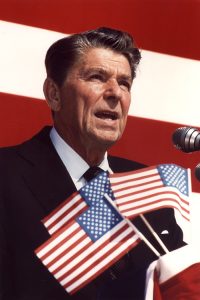
(Ronald Reagan Presidential Library)
The nail in the coffin was the influence President Ronald Regan had upon the decision to repeal the FD. His championing of the idea of de-regulation, which he wanted to remove governmental affairs from most of the American systems to ensure that individuals had the most power than the government themselves, including the regulation of the media.
In hindsight, the FCC did underestimate how the media evolved, given the accelerated rise of technology — especially the introduction of cable, and competition in the field of information. I personally feel like removing it rather than updating the regulatory statutes in a more modern way would’ve been better than getting rid of it, which became one of the biggest factors that lead to the polarization of modern society. This change could be justified by the opening of Pandora’s box.
The effects after the removal of the FD was crystal clear. The rise of partisan talk radio, which ultimately threw out facts for opinion on politics, led to the rise of bias without factuality. Rush Limbaugh, alternative to mainstream media often offensive, a main driving force behind polarization threw out the facts when talking about politics and engaged with his audience on their personal level. This pattern of personality-driven commentary continues today through figures like Joe Rogan and the Rubin Report, who similarly blend opinion, entertainment, and political discussion for massive audiences. Their influence shows how the post-FD media landscape still rewards emotionally resonant, perspective-driven content over balanced presentation.
Historians and Political Science experts coined it “Rush Limbaugh era,” given the easy access to information, mainly public broadcasting radios when driving, morning stations, etc — connecting with his audience speaking without filter and credibility. He influenced the modern landscape of reporting which makes people react in the extremes overlooking into issues themselves.
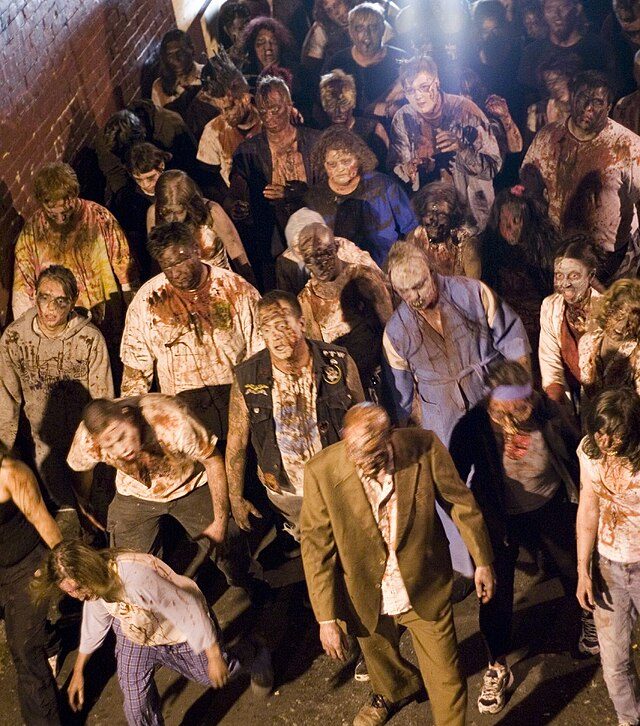
Coinciding with Limbaugh, established news networks primarily Fox News, and MSNBC, saw the writing on the walls and observed the numbers they can attain when appealing to the people’s emotions with inflamed rhetoric, fueling the rise of echo-chambers. Additionally, the rise of social media echo-chambers can be acquitted through the ideals sprouted from the mainstream media. Platforms such as, X (Formerly Twitter), and Reddit are prime examples of the modern-version of conforming to political rhetoric without keeping an open-mind and choosing for themselves; not letting someone else’s opinion dictate their future.
Tribalism, the intense loyalty to one’s social group, continues to shape political, cultural, and social behavior around the world. A 2024 Gallup survey found that 58% of Americans reported feeling stronger affinity with groups that share their political or cultural beliefs, a trend that becomes especially visible in the modern partisan media landscape.
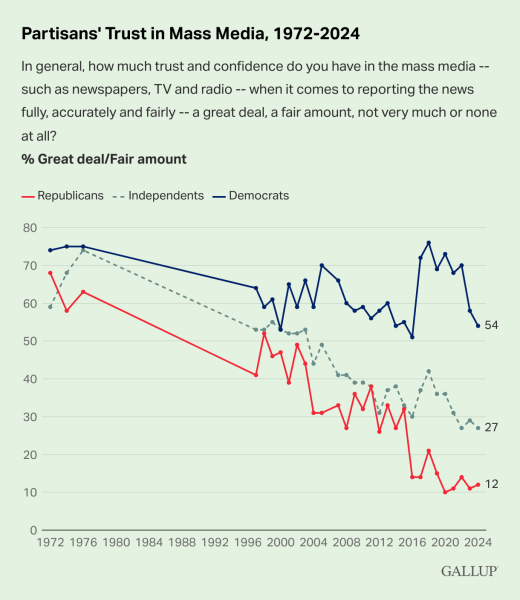
Alongside rising tribalism, Americans’ overall trust in the media has fallen to historic lows. Gallup’s “Trust in Mass Media, 1972–2024” chart shows a dramatic long-term decline, dropping from the high-trust era of the 1970s to one of the lowest points ever recorded in 2024. The percentage of Americans who say they trust the media “a great deal or fair amount” has steadily eroded, while distrust has grown sharply. This trend reflects a media landscape that has become increasingly polarized and fragmented, especially in the decades following the repeal of the FD. Without a shared expectation of balanced coverage, audiences gravitate toward outlets that confirm their beliefs, deepening skepticism toward any source outside their preferred bubble.
Let’s distinguish between two concepts: Healthy media pluralism vs. Fragmented, partisan information silos. Healthy media, refers to a diverse and competitive media landscape where multiple forms of information and viewpoints are available to audiences. This diversity is essential for fostering democratic discourse, ensuring that various voices are heard to prevent concentration of media ownership. In turn, this supports the healthy ecosystem of a democracy by enabling citizens to access a variety of viewpoints, informational sources which can help them make formal, rational decisions.
On the other hand, partisan, fragmented information silos derive on the basis of subjective political affirmation, where the media tells the viewer how to feel, instead of allowing the individuals to evaluate information for themselves. In my view, the repeal of the FD opened the door to the chaotic media atmosphere we have today, where biases, weak transparency, and emotionally charged rhetoric — fueled the inevitability of polarization.
Albeit, the circumstances are relatively different. For starters, it isn’t 1949 anymore; the world has changed in many ways than not: advancement in technology, globalization of the world, and the easy access to information. For a reinstatement of a Modern FD, a few solutions can be implemented to fit the current times. Transparency for algorithms on both social media and the mainstream media is vital. Moreover, there should be clear labelling of opinion vs. news which would drastically change the way citizens would view current events. No longer curated news to fit an agenda, if they want to hear people’s voices choose opinion; objectivity that’s straight to the point should just be “news,” where people should be able to think for themselves.
Additionally, public interest should always trump the individuality of current mainstream news, where the top 10% hold financial stakes and control over what information is being presented and what is being omitted. Instead, there should be some governmental oversight regarding giving licenses to mainstream news; civilian oversight should be included that’s as well rooted for objectivity and not bias. If bias is demonstrated, people can report the news station, and the government would either revoke their ability to broadcast or congressional investigation. To not conflict with the First Amendment, “bias” would have to be defined narrowly — specifically as the intentional use of misleading framing, emotional, emotional, or knowingly false information designed to push viewers towards a predetermined conclusion.
If implemented, critics would argue that these would prevent free-speech violating the 1st Amendment. However, reporting on objective news is different from speaking on the issue profusely. The goal is not to restrict opinion but to ensure that factual reporting remains top priority, where transparency, accountability, and insulated from private influence. A modernized oversight system would simply create guardrails that protect the public’s right to reliable information without dictating what viewpoints can or cannot be expressed.
After understanding everything now, I want everyone to consider — should the fairness doctrine return, and if so, how do we ensure it stays fair in a world far more complex than the one it was created for? After examining its history, its repeal, and the polarized media landscape we now live in, I take a pro-reform but cautious stance, supporting modern transparency and accountability measures without giving the government unchecked power over speech. A balanced approach is possible, but only if reforms are designed to protect the public interest rather than control public opinion.
For Richmond Hill students and staff, the takeaway is simple but urgent: media literacy matters. Understanding bias both in the news and in ourselves is essential to navigating today’s information chaos. Our community is directly affected by misinformation, whether through politics, public health, or local issues. In the end, the most powerful safeguard isn’t a policy; it’s a public that questions sources, that thinks critically, thinks for themselves, and refuses to accept information at face value.
Work Cited:
Fairness Doctrine | Research Starters | EBSCO Research
Fairness doctrine | History, Provisions, Repeal, & Facts | Britannica
Fairness Doctrine | Ronald Reagan
Talk radio and the lasting impact of Rush Limbaugh | Virginia Tech News | Virginia Tech