














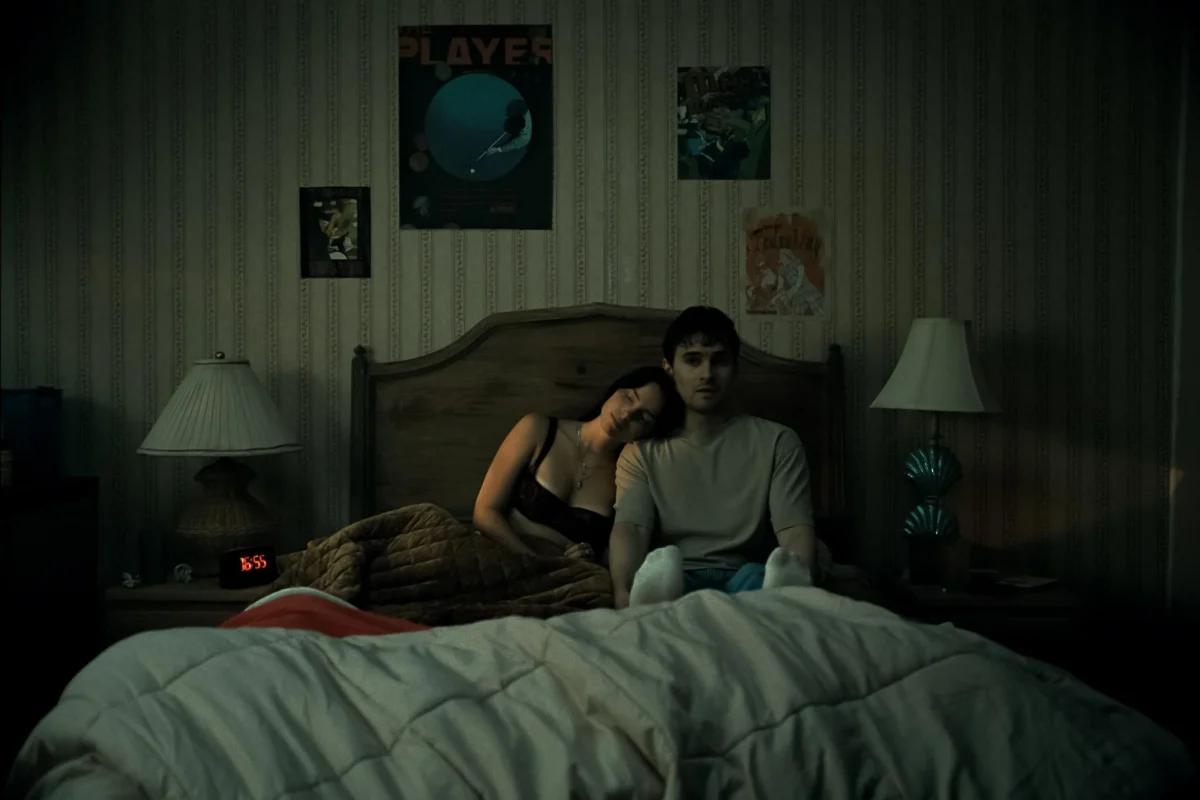




Wishing for someone to fall in love with you is one of the few wishes a genie would never grant. But if that wish came true, would you really want it?
Obsession is a rated R psychological horror film written and directed by YouTube creator Curry Barker. With a budget of 750,000, the film premiered at Toronto International Film Festival and went on to become a breakout success, earning a 94% rating on Rotten Tomatoes, an 8.1/10 on IMDb, and grossing over $286.5 million worldwide.
The story follows Bear (Michael Johnston), a socially awkward music store employee who is grieving the death of his cat, Sandy, and quietly struggling with loneliness. He is also interested in his co-worker Nikki (Inde Navarrette), but lacks the courage to confess his feelings.
At the start of the film, Nikki is considering leaving her job to pursue writing, reflecting a more expressive and forward-moving personality compared to Bear’s quieter, more restrained nature. This becomes a key reason Bear feels pressure to finally confess his feelings before she moves on entirely, but once again, fails to do so.
Everything changes when Bear purchases a strange antique trinket known as a “One Wish Willow.” Thinking it’s nothing more than a novelty, he wishes for Nikki to love him “more than anyone else in the entire world.”
At first, nothing seems to happen. But soon after, Nikki begins to change in disturbing and unnatural ways, becoming intensely fixated on Bear. What begins as a fantasy quickly turns into something far more unsettling, as Bear realizes his wish may have stripped Nikki of her autonomy entirely.
What makes Obsession effective is not just its plot but also the details in the movie. The movie focuses on the themes of consent, control, and the difference between love and possession. The central horror of the film is the erasure of Nikki’s will, which reinforces the idea that love without choice is not love at all.
While the film’s themes are relatively clear, Bear’s role within them is far more open to interpretation.
A common reading is that Bear is the villain of the story. It’s understandable why. He makes the wish believing it’s harmless, refuses to immediately undo it once things go wrong, and at one point even tries to alter it rather than erase it entirely. There is also a moment where Nikki, in her broken state, begs for death, and Bear’s refusal adds further moral weight to his choices.
But Bear isn’t purely evil.
When the film begins, His is grieving the loss of his cat and already emotionally isolated. He is depressed, insecure, and quietly building up the courage to confess his feelings to Nikki. When he makes the wish, it doesn’t feel like an act of control. It feels like the desperate decision of someone who doesn’t believe it will actually work.
The moral complexity comes after the wish is granted. Bear is suddenly confronted with a reality he never understood. Nikki’s affection is overwhelming, controlling, and unnatural. With that observation, instead of undoing it, he hesitates. He tries to adjust the outcome rather than erase it completely.
The hesitation is what defines him.
Obsession works best as a morally grey tragedy rather than a simple story of good versus evil. Bear is not driven by cruelty. He is driven by grief, insecurity, and a desperate need to be loved. His downfall comes not from hatred, but from the inability to let go of something he has always wanted.
The film also uses visual language to reinforce these ideas in subtle but powerful ways.
When Nikki was under the influence of the wish or the supernatural force behind it, she is often seen in red or has traces of red on her. Red can be suggested as distortion, danger and unnatural desire. At other moments, she appears in muted tones that reflect Bear’s colors. This muted tone reflects Bear’s idealized version of her, as if her identity is being softened and reshaped to fit his perception. At the beginning and end of the film, however, Nikki is dressed in black which i interpret as her true self, separate from both the wish and Bear’s influence.
Lighting plays a similar role. When Nikki is no longer behaving like herself, she is frequently back lit, with her face obscured and only her shadow visible. This creates a sense of distance, as if her identity is physically present but emotionally reachable. In contrast, when Bear’s choices become more orally questionable or emotionally unstable, the film sometimes removes the warmth from the frame entirely, leaving scenes cold and hollow.
Taken together, these visual choices reinforce the central theme: identity and love are being controlled by forces that distort how people see each other.
Ultimately, obsession is a film that resists a single interpretation. Some viewers will see Bear as the true monster of the story. Others will see him as a flawed, grieving person who makes irreversible mistakes in the pursuit of love. Both readings feel valid. And that tension is what makes the film linger after it ends.
Whether you disagree or agree, Obsession is the kind of film that invites discussion rather than delivering a simple answer, and that alone makes it worth watching.